What We Carry
Solo Exhibition by Jairo Cortes-Marin
621 Gallery
04.03.2026 Opening Reception
What We Carry is composite. A convergence of registers. Eclectic through the distinctly autobiographical manner in which @jairo_ema25 constructs his narrative.
The artist’s multidisciplinarity, in conjunction with his multicultural inflection, brings forward a curated series of states, hand-picked through artistic gestures at a human scale. Their particularities negotiate limits, erode boundaries, and place us within a shared DMZ. An open invitation to lower our guard, extended naturally through personal example. The complexity with which he composes and assembles familiar elements shifts the discussion into a semiotic field that, for me as a viewer, becomes humbling. A work such as Urban Echoes – Leisure or Luxury? stands testament to this.
Beyond an aesthetic muscle formed on a composition that works on so many levels, the narrative built through symbolism and the precision of arriving exactly where it needs to be, somewhere on the Cartesian axis where only there it makes sense for the photograph to be taken, thus to exist, captures the duality of two antonyms. Each of us is left to choose our freedom. If time is money, I’d rather walk, thank you.
This capacity to engage large questions through small gestures introduces a vertical dimension to the work. It becomes visible in the inward turn that follows. Mitá y Mitá illustrates this without any pretentious ambiguity.
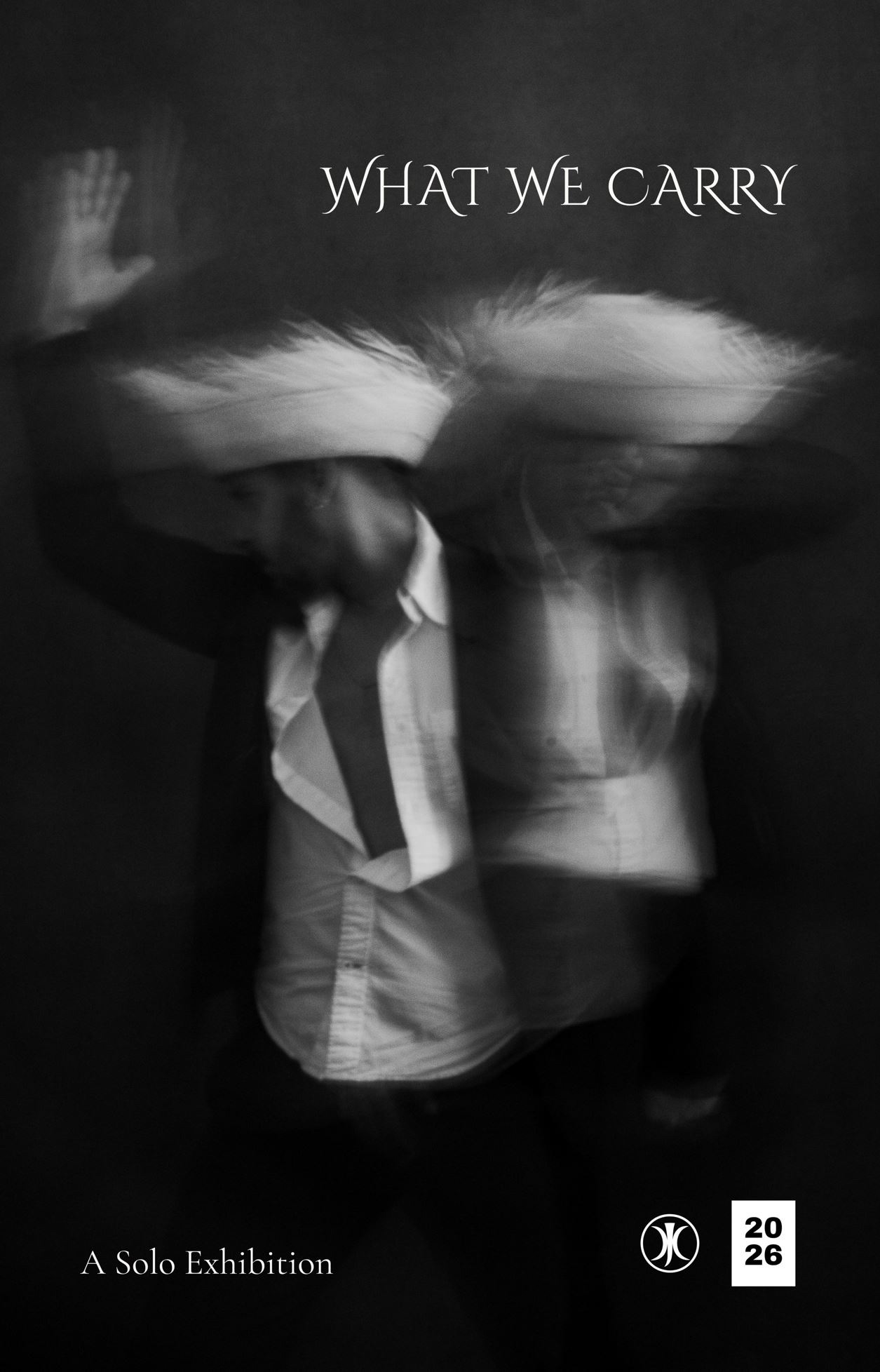
A series of eight black-and-white long-exposure self-portraits. The circle opens here. The long exposure foregrounds, almost literally, the necessity of time. Of pause. Speaking of pauses, I think this is as good a moment as any to introduce a few factual details about Jairo, as I got a bit carried away.
Jairo Cortes-Marin is a multidisciplinary visual artist whose practice spans photography, text, and painting. Working predominantly in black and white, his work examines the interplay between identity, memory, temporality, and collective experience, oscillating between observation and abstraction. Over the past decade, he has developed independent bodies of work concerned with how personal and social histories are carried, inherited, and reconfigured, alongside contributing to exhibitions and projects across contemporary art contexts.
I’ve known him for close to a year. The conversations, some brief, others extended over weeks, have been among the most vivid and grounded I’ve had in this space. There is consistency between the work and the person.
I’ve only scratched the surface of what unfolds in What We Carry, so I chose to step back and let Jairo take it from here.
Questions:
1. As mentioned earlier, and as you yourself have described the process and the path behind building these bodies of work, everything is highly autobiographical — as, in my view, any work should be at its most authentic. When and how did it shift from what I carry to what we carry? Was there ever a clearly defined what I carry at the beginning?
It’s very interesting to consider a question like this. I’m not sure there was a precise point where anything shifted. I’ve always been drawn to the dynamics at play between the individual and the collective experience. Perhaps having moved around early in life primed me through exposure. But nonetheless, it’s always been very present for me how there’s these subtleties to being human that we’re often unaware of as we move through daily life.
When considering my work, I think I’ve always walked a fine line between creating pieces that serve me, but can also serve others. I’ve leaned on that more and more as the years go by. It ebbs and flows, at times more external looking, at others more inward facing. Always surrounding the same themes.
Time plays a big role in this for me, as does legacy.
Since I was young I was fascinated with history and the almost cyclical nature of time’s passing. That’s been foundational in how I perceive time – always aware of how I’m creating things that are meant to outlive me. And if I’m thinking retrospectively from said future, what would I have liked to say? Blending that forward looking perspective, with the act of slowing time down – as with photography – and a beautiful juxtaposition emerges. I frequently draw inspiration from this outlook on time.
So when What We Carry came around in concept, it felt natural. It was less of trying to shift and more of aligning what was already there. The real challenge was creating a space where both aspects could coincide, complement the other and gain new meaning by proximity.
Alone, each body of work presents either my own story or the story of how I see the world. Together, they amplify each other to create a bridge where it’s not just my own story anymore, but a reflection of our collective experience via my perspective – no longer just what I carry, but what we carry.
2.If the visual medium is monochrome, would you say the same applies to the written component of the exhibition?
In a way, yes. Where my visual work is monochrome in nature – out of purpose more than aesthetics – my written work echoes it in its own fashion.
One reason I’m drawn to monochromatic work, particularly black-and-white, is the way in which it strips down the distractions and reveals the shades of grey – both literally and figuratively. I think the essence of that also applies to the writing I do. My poetry exists in the grey, in the liminal and often either unnoticed or unacknowledged. It’s at times uncomfortable or difficult to sit with, just as the grey areas of life are. And that’s the point.
A similar principle applies to the writing when considering contrast. In black-and-white photography, a big focus of mine is the interplay of light and shadow. My writing isn’t an exception to this, with most of my written work swaying between the two – both from a first person perspective or the more collective in nature.
For What We Carry in specific, the poetry is very contrasting. It’s presented as an audio installation, divided into two volumes – each facing a different direction and reinforcing the binary of the exhibition as a whole.
Vol. 1, titled Noise, is external facing, social in nature and collective in spirit. At the gallery, this one is paired with the Urban Echoes section that contains all the street photography. Whereas Vol. 2, titled Flow, is the antithesis to this and marks the shift around which the entire exhibition revolves. That volume is paired with Mita y Mita and carries that same self-reflective and almost reverential energy the images have.
Different medium, same echo.
3.How do the mediums — visual, audio, and written word — intersect? Where does one begin, and where does it dissolve into another?
In my practice in general, I see them all as a different means of expressing the same personal philosophy – they’re complimentary, mutually expansive and a tad bit codependent. Each gives me the ability to express something the other can’t, but either needs or benefits from. They inform each other, play off one another and mutually complete the context.
For this exhibition in particular, that’s even more noticeable. I was able to create a loop between the three mediums where I don’t see it as one coming before the next, but rather each enhancing the overall message.
One thing is seeing the images, reading the poems or hearing their recitations. They each have intrinsic meaning and are solid standalone. But once they share space they begin this dialogue where one piece adds to the next – the interplay of image, sound and text starts to reveal deeper layers in the other. It’s as if engaging with individual pieces lead you to discover new passages in the conversation between mediums.
It was actually very special to witness this in person. People would bounce back and forth between the different walls and go back to relisten to the recordings, all the while having conversations – many with me – where I realized the loop actually translated from idea to actuality. The mediums didn’t feel separate and it became apparent to me that I had created different entry points to the same experience.
4.I noticed within the body of work an assumed and active closeness to divinity, something I appreciate in any artist who manages to carry their personality unaltered and unfiltered, without the restraint of fear in today’s broader context. How does your vertical relationship with God manifest today? How does it position itself within your practice as an artist?
Divinity is a fascinating subject to me and my relationship with the Divine has evolved quite drastically over the years. I grew up in a very Catholic family, in a largely religious country. At the same time, I was aware that my grandparents practiced Santeria – though I never fully understood to what extent. That combination exposed me to experiences early on that I still can’t fully explain. Some defied all sense and I’m not sure I’ll ever fully understand them. However, looking back, I’m grateful for the sensibilities they gave me.
As I got older, I began to question more deeply and started searching for answers. That search eventually led me to the conclusion that there’s something more to life than physicality. Some describe it through religious doctrine, others explain it away through quantum mechanics. I’m not savvy enough to provide answers, but what I do know is that there seems to be something larger than us bringing order to chaos and chaos to order.
Whether people call it God, the universe or something else entirely, I’ve come to see it as a unifying presence that’s both present in and moves through everything.
For a time, I rejected that idea altogether – partly due to my own misunderstandings, and partly out of frustration with the world around me. But over the years, I found my way back to it in a more personal and grounded way. So much so that now the act of creation has taken a spiritual role in my life.
The way I see it now, if I was blessed with the talents I possess, I have a responsibility to use them for a greater purpose – as cliche as it may sound. I’ve come to a point where I’ll open studio sessions through prayer and place myself in God’s hands, as to let my work serve whatever purpose the Divine seeks of me. This was probably the clearest lesson I took away from the process of making Mita y Mita – letting my work serve.
It’s been both freeing and humbling to arrive at this place.
The path here wasn’t linear – I had to lose my sense of direction, my faith, and myself in the process. But I’ve rebuilt that relationship with clarity, bringing me a sense of gratitude that’s hard to put into words. And surely there’s the chance I could lose it all again, that’s not lost on me. But letting God back into my life and practice has been life altering. That trust continues to shape both my life and work.
I wouldn’t change a thing.
5.Does this body of work move toward a reconciliation between an older world and a newer one?
That’s a keen insight – in short, yes.
It’s a body of work born from reconciliation. Different wounds, mindsets and periods of my life come together to make peace with my present. It’s a sort of ending or culmination of a stage in both my life and career – which has almost symbolic timing, considering I turn 30 this year.
But beyond that, it’s also a beginning to a new cycle – one where the dialogue between present and future are prescient. As the gray hairs start kicking in, it seems that what once appeared to be distant no longer is and the current state of the world has me contemplating mortality more often. Not necessarily my own, I made peace with that long ago. Society’s.
Modern times feel existential – or are primarily portrayed as such – and the world I grew up in hardly exists anymore. This has brought an onslaught of questions both for me and society at large, where I’m not clear where we’re headed. On one side, things could go apocalyptic – mass media banks on this unfortunately. On the other hand, we could be on the cusp of the greatest transformation in human history – one that could fundamentally alter our very phenomenology. That’s hard to digest even on a good day.
Yet the reality is, we aren’t just observers in this equation. What we do or don’t do now will dictate which scenario becomes more likely in the future. My work now straddles this tension – with What We Carry being the shining example in practice.
The ideas I present in this exhibition aren’t new to me, but they are the clearest version of them I’ve articulated thus far. I don’t see myself deviating from this lane anytime soon. If anything, I'd like my work to continue being a conduit for these kinds of existential conversations – to help us reconcile our present with the future we genuinely desire and what it’ll cost us to get there, or not.
Whether I succeed or not in adding value to the conversation, time will tell, I’m happy to wait. In the meantime, I’ll continue presenting the world with what we carry.
-Jairo Cortes-Marin
I don’t feel the need to conclude this. I’ll leave it there. Jairo, much love for accepting my invitation and same amount of love to everyone that stuck around till the end.